Why Colour Identification on Screeds Matters More Than You Think
Walk onto most construction sites and you'll see a dozen different trades working in close proximity, often with only days between one process finishing and the next one starting. Screed is no exception. Once it's poured and curing, it can be difficult, often impossible, to tell at a glance exactly what product went down, what its drying characteristics are, whether it needs to be covered in primer before laying tiles, parquet or vinyl on top of it, and when it's genuinely ready for the next stage of work.
That ambiguity isn't just inconvenient. It's a real source of risk on site, and it's exactly the problem that our coloured screed binders are designed to solve.
The Problem With "It All Looks the Same"
Liquid and flowing screeds can look remarkably similar once poured, regardless of their underlying formulation. A traditional sand-cement screed and our ECO screed can cure to a near-identical grey finish, leaving site teams to rely on paperwork, memory, or guesswork to know which is which. Until recently, it was the same for our ECO screed and its fast-drying, early-to-cover counterpart, ECO FD E2C, which were both grey. To complicate matters, our XTR and XTR FD E2C binder variants were also the same colour.
That used to create problems for everyone involved:
- Follow-on trades didn't know whether a floor was ready for flooring, tiling, or other finishes, leading to either costly delays or, worse, work starting too early and causing failures further down the line.
- Site managers and stakeholders, who need to track multiple areas, phases, or rooms, sometimes poured with different products for different performance requirements, without a simple way to visually confirm what's underfoot.
- Future refurbishment or maintenance teams, sometimes working on a building years later, have no easy way of identifying what screed was originally installed, which matters when planning removal, repair, or compatibility with new floor coverings.
A Simple, Visual Solution: Colour-Coding by Product
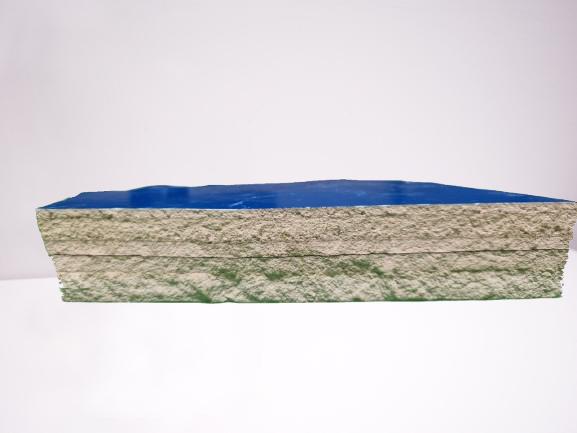
This is precisely the thinking behind ANHYDRITEC UK's latest developments. The ECO FD E2C and XTR FD E2C technologies - both fast-drying, early-to-cover formulations - are now produced in two distinct shades of blue, clearly setting them apart from their regular, non-FD E2C counterparts.
It's a deceptively simple change, but the impact on site is significant. Instead of relying purely on documentation, anyone on site can now identify immediately whether a fast-drying, early-to-cover screed has been used, simply by its colour.
How This Helps Trades on Site
For trades working around or after the screed pour, colour identification removes a layer of uncertainty. A visibly blue substrate (as in XTR FD E2C and ECO FD E2C), or a red floor (as in THERMIO MAX FD E2C) signal a fast-drying, early-to-cover product, giving flooring contractors, electricians, and other follow-on trades immediate visual confirmation of what they're working with, without needing to track down paperwork or ask around. Our thin-section EXCELIO technology comes in light green to indicate that the screed is suitable only for bonded applications. The even thinner FINIO, on the other hand, is a teal green, indicating that the screed layer is not suitable for bonded floors. This supports faster, more confident decision-making about when it's safe and how best to proceed, reducing the risk of work being held up unnecessarily or started prematurely.
Why This Helps Other Stakeholders
Site managers, quantity surveyors, and clients all benefit from being able to visually verify what's been installed where, particularly on larger or phased commercial projects where different screed types might be used across different zones. Colour identification adds a layer of transparency and accountability, making it easier to cross-check installations against specifications and programme timelines at a glance.
Future-proofing Floor Refurbishments
Perhaps the most valuable long-term benefit is for anyone coming back to work on a building months or years down the line. Refurbishment and maintenance teams often have limited information about what's beneath a finished floor, and the surprise they encounter may leave them unprepared, requiring new orders, multiple trips and transportation costs, and even learning new skills. A distinct colour offers an immediate, physical clue as to the type of screed originally installed, helping inform decisions around removal, compatibility, and repair, long after the original installation team and documentation may no longer be readily accessible.
A Small Change With a Big Impact
Colour-coding screed products isn't a gimmick; it's our practical response to a genuine site problem. By giving the ECO FD E2C and XTR FD E2C technologies their own distinct shades of blue, ANHYDRITEC UK is making it easier for everyone on site, and everyone who comes after, to know exactly what they're dealing with, at a glance.
It's a small visual cue, but one that supports safer sequencing, clearer communication, and better-informed decisions across the entire life of a building.